When the Album Became a Listening Sequence
Learn how an album listening sequence shapes attention: hear how track order, transitions and contrast change the way songs work together.
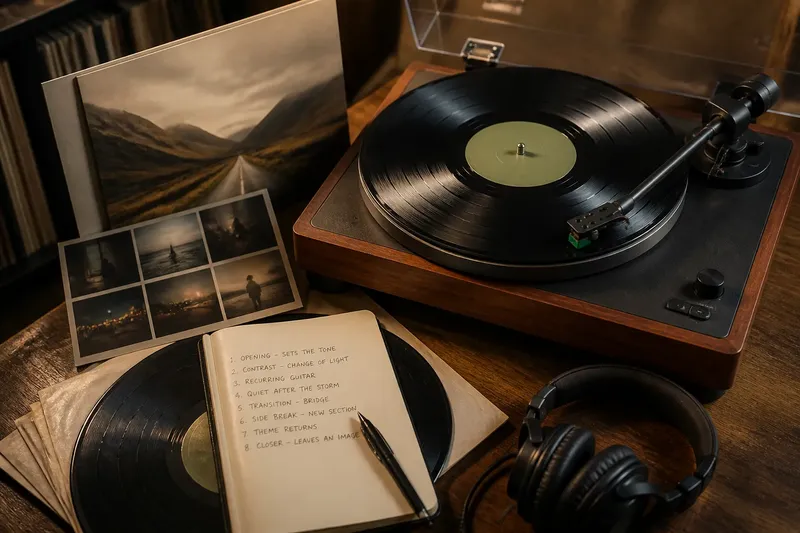
The common mistake with an album listening sequence is to treat the track list as a row of separate songs, then blame the music when the whole record feels uneven. That can cost you the relationships created by order: a track may prepare, interrupt or reframe the one that follows.
An album can be a collection without behaving like a continuous work. To hear the difference, follow the tracks in their presented order and notice how their sounds, moods and endings carry into one another.
The album gathered recordings before it became a sequence
In the early commercial record era, releases often presented individual recordings, while collections brought several pieces together in one package. Some collections used bound sets of discs, a format that helps explain the word “album”. These objects grouped recordings, but grouping alone did not make their order a musical argument.
A collection might be united by performer, style or subject and still invite listeners to select a single piece. A sequence asks you to hear the connections created by placement. A bright opening can make a restrained follow-up sound like a deliberate change of direction; a recurring image can bring two otherwise distinct songs into conversation.
The distinction is useful when an album feels varied. Rather than asking whether every track sounds alike, ask whether the order gives the differences a shape.
Long-playing records gave sequences room to unfold
Long-playing records, commonly called LPs, offered more playing time on a disc than earlier short-play formats. This made it more practical to issue a substantial group of recordings together, though an LP did not require musicians to make a unified work. Some releases still prioritised variety and individual appeal.
The two sides also supplied a natural pause. A side could end with a sense of closure or leave a sound unresolved; turning the record then gave the listener an interval before the next section. The physical act of changing sides could become part of the listening rhythm, but it did not have to carry artistic meaning.
Longer playing time made it easier to consider pacing across a side. A quieter performance after a dense one might feel exposed, while a repeated instrument could link tracks. These are possible effects to listen for, not rules about what an LP should do.
Track order changes how songs meet
The opener sets a point of entry. It may introduce the album’s sound, establish a mood or begin somewhere that only becomes clear after later tracks. The closer shapes the departure: it can offer resolution, leave an image hanging or echo the beginning.
Between them, contrast can do as much as continuity. A sparse arrangement after a crowded one may feel newly intimate; heard alone, the same track might simply sound quiet. A short instrumental can act as a threshold, and an abrupt ending can make the silence before the next song feel charged.
Use these checks while listening. Each one links an audible observation to a practical decision about what to listen for next:
- Check the handoff. If the next track answers or continues the previous one, listen for a musical or lyrical link; if it cuts sharply away, consider whether the contrast changes the mood.
- Check for recurring material. If an instrument, rhythm, image or vocal treatment returns, compare its role across tracks; if nothing recurs, listen instead for changes in texture or energy.
- Check the emotional shift. If a playful track gives way to a sombre one, treat the turn as a possible change of direction; if the mood stays steady, notice what keeps the sequence moving.
- Check the midpoint or side break. If the music gathers momentum or changes course there, follow that shift into the next section; if it does neither, hear the break as a practical division rather than a hinge.
- Check the gaps between tracks. If a sound carries across the boundary, listen for a continuous transition; if there is silence, decide whether it feels like a reset or a pause that sustains the previous track.
- Check the ending against the opening. If the closer recalls an earlier sound or idea, compare how its meaning has changed; if it does not, consider what feeling or image it leaves on its own.
These checks are prompts, not a test every album must pass. A loose sequence can be satisfying because each track offers a different scene; the useful question is what the order makes you notice that isolated songs might not.
Recording choices can connect or separate tracks
Albums can be shaped through more than song selection. Editing, layered performances and choices of sound can create a shared character; a change in room sound or arrangement can mark a new section. The unity may come from audible details rather than a shared story.
Transitions offer another way to shape attention. One track may run into the next, a short passage may bridge different settings, or a clean gap may give the listener time to reset. Listen for whether a boundary feels continuous, abrupt or silent, then notice what that does to your attention.
Not every effect requires a recurring motif or an explicit concept. If a gentle song follows a noisy one, it may feel like release; reverse the order and the noise may feel like an intrusion. Hearing the tracks in sequence lets you experience those relationships as they develop.
What does an album listening sequence reveal?
Does every album have a story?
No. Some albums use a narrative or concept, while others work through mood, contrast, recurring sounds or a varied run of songs. Listen for relationships between tracks before assuming there is a plot to decode.
Why do opening and closing tracks matter?
The opener sets expectations, while the closer shapes the sense of departure. Their effect depends on what surrounds them: a quiet ending after a forceful run may feel like release, while an unresolved final sound can linger.
Should I listen to the original track order?
For a first attentive listen, the presented order makes the intended handoffs easier to hear. Rearranging tracks later can be an interesting comparison, but it answers a different question: how the songs work together in your chosen order.
What changes when I listen on shuffle?
Shuffle can draw attention to individual songs outside their original context. It also changes the planned handoffs and the effect of the opening and closing positions, so it offers a different way to hear the music rather than a neutral substitute.
Digital playback changes how listeners encounter the order
Digital files and streaming make it easy to move between tracks, save individual songs or play an album out of order. That flexibility makes the sequence less compulsory, but the presented running order remains available to anyone who wants to hear it.
Playback settings can affect boundaries. Crossfades may blend tracks, gapless playback may preserve a continuous transition, and a player’s display may foreground the cover or track list. Listen for a lingering note, a change in ambience or a deliberate silence, and decide whether the next song feels like a continuation or a reset.
For an unfamiliar release, start with the complete album in its presented order and leave explanations until later. Notice where your attention shifts and which tracks feel connected. On another listen, focus on one feature, such as recurring instrumentation or the placement of quieter songs.
Say you begin an unfamiliar album during a noisy commute and keep skipping tracks that do not catch you immediately. Imagine saving the same release for a quiet evening: you play the presented order and notice that a short instrumental carries a melody from the preceding song into a slower one. The result is a clearer sense of transition; if the sequence still feels loose, you can hear that as part of the album’s character rather than a failure to listen correctly.
Order gives neighbouring tracks a relationship
Albums have taken different forms, and no single format made every release a unified work. But whenever tracks are presented in an order, their neighbours can affect how each one lands. A song does not have to tell a fixed story to sound different after another song.
Give an unfamiliar album enough uninterrupted attention to hear a complete side or continuous section, then return to the point that changed your sense of the whole. The album listening sequence is not merely a convenient list: it is the relationship between tracks as one prepares, complicates or reframes the next.